
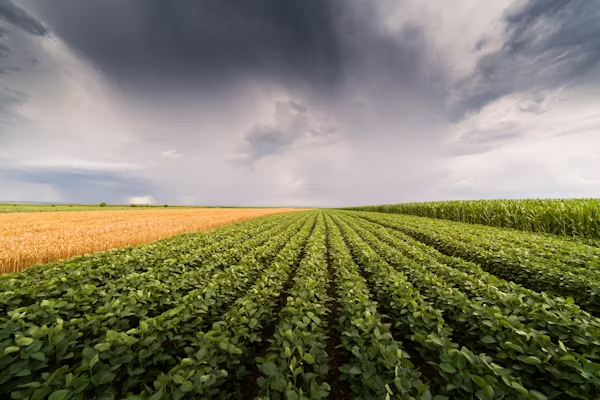
Food security, the ability for all people to have reliable access to safe, nutritious food is one of the biggest global challenges in 2025. Climate change, with its rising temperatures, unpredictable weather, and droughts, directly threatens how and where we grow food.
This is where climate-resilient agriculture (CRA) steps in. It combines sustainable practices, innovative technologies, and local knowledge to ensure stable food production despite climate shocks.
Why Food Security Depends on Climate Resilient Agriculture
- Climate threats: Rising CO₂, floods, and heatwaves reduce crop yields.
- Population growth: By 2050, the global population is expected to reach 9.7 billion, demanding 60% more food.
- Resource scarcity: Limited land and water call for smarter farming.
Without climate-smart solutions, food insecurity will rise, particularly in vulnerable regions like Africa, South Asia, and Latin America.
Key Strategies for Climate Resilient Agriculture
1. Climate-Smart Crop Varieties
Scientists are developing drought-tolerant, flood resistant, and pest-resistant crops to secure harvests in unpredictable conditions.
Example: Heat resistant wheat and rice varieties are now used in Asia and Africa.
2. Sustainable Water Management
- AI driven irrigation systems conserve water.
- Rainwater harvesting reduces dependence on groundwater.
- Drip irrigation increases efficiency by up to 70%.
3. Agroforestry & Biodiversity
Mixing trees with crops improves soil health, reduces erosion, and captures carbon, creating more resilient farming ecosystems.
4. Digital & AI Powered Agriculture
- AI tools predict weather and crop disease outbreaks.
- Drones monitor soil health and water needs.
- Mobile apps connect farmers to climate adaptation knowledge.
5. Regenerative Farming
- Minimal tillage to protect soil.
- Organic fertilizers instead of chemicals.
- Practices that store carbon in the soil while boosting yields.
Global Efforts to Secure Food in a Changing Climate
- FAO (UN Food and Agriculture Organization): Promotes global food security policies.
- World Bank & IMF: Financing climate-smart agriculture projects.
- Local farmer cooperatives: Sharing traditional and modern adaptation strategies.
Case Study: Kenya’s farmers adopting drought resistant maize with digital irrigation systems, improving yields by 30%.
Benefits of Climate-Resilient Agriculture
✔️ Protects smallholder farmers from income loss.
✔️ Ensures consistent food supply.
✔️ Reduces dependence on harmful chemical farming.
✔️ Builds sustainable, resilient economies.
✔️ Supports global climate goals by lowering emissions.
Challenges Ahead
- High initial costs of sustainable technology.
- Lack of training for smallholder farmers.
- Political and trade barriers to food distribution.
- Unequal access to digital tools in rural areas.
Governments and private sectors must invest in education, financing, and technology transfer to make CRA widely accessible.
The Future of Food Security & Farming
By 2030, experts predict that climate-resilient agriculture will be the backbone of global food systems. The future will include:
- AI driven farming hubs powered by renewable energy.
- Climate insurance schemes protecting farmers.
- Expanded use of vertical farming in cities.
- Blockchain-based food traceability for transparency.
Final Thoughts
Food security and climate-resilient agriculture are deeply interconnected. To feed billions of people in 2025 and beyond, we must embrace innovation, sustainability, and collaboration.
By investing in climate smart solutions, we not only secure food but also protect the planet for future generations.
FAQs | Food Security & Climate Resilient Agriculture
Q1. What is climate-resilient agriculture?
It’s a farming approach that adapts to climate change while ensuring food security and sustainability.
Q2. How does climate change affect food security?
Extreme weather, droughts, and rising temperatures reduce crop yields and disrupt food supply chains.
Q3. What are examples of climate-resilient practices?
Drought-resistant crops, AI powered irrigation, agroforestry, and regenerative farming.
Q4. How can technology improve food security?
AI, drones, and digital platforms help farmers predict risks, optimize resources, and increase yields.
Q5. Which regions are most at risk?
Sub Saharan Africa, South Asia, and parts of Latin America face the highest food security risks.