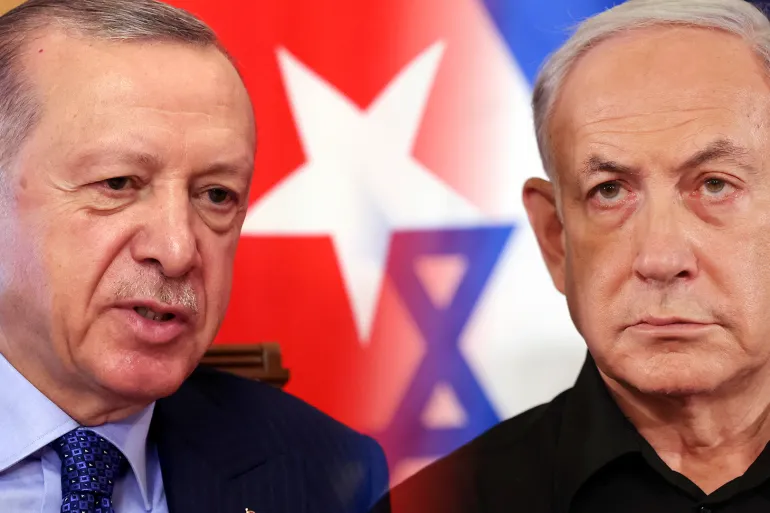
Following Israel’s Doha strikes, Ankara is increasingly on high alert over Tel Aviv’s regional ambitions.
Istanbul, Turkiye – Just hours after Israel launched strikes last week against Qatar, a United States-designated “major non-NATO ally” and one of Washington’s closest Gulf partners, pro Israel commentators quickly shifted their attention to Turkiye.
In Washington, Michael Rubin, a senior fellow at the right-leaning American Enterprise Institute, suggested that Turkiye could be Israel’s next target and warned that it should not rely on its NATO membership for protection.
On social media, Israeli academic and political figure Meir Masri posted, “Today Qatar, tomorrow Turkey.” Ankara responded sharply. In unusually harsh language, a senior adviser to President Recep Tayyip Erdogan wrote: “To the dog of Zionist Israel … soon the world will find peace with your erasure from the map.”
For months, pro-Israel media outlets have steadily escalated their rhetoric against Turkiye, portraying it as “Israel’s most dangerous enemy”.
Israeli commentators have also framed Turkiye’s presence in the eastern Mediterranean as a “threat” and its role in rebuilding post-war Syria as a “new rising danger”.
With Israel’s regional aggression escalating and its war on Gaza showing no sign of ending, Turkish Foreign Minister Hakan Fidan retaliated in August by suspending economic and trade ties with Israel.
“In Ankara, this [anti-Turkish] rhetoric is taken seriously, with Israel seen as seeking regional hegemony,” Omer Ozkizilcik, non resident fellow at the Atlantic Council.
The strikes on Qatar also likely underscored Ankara’s doubts about US security guarantees as a NATO ally. Despite Doha’s special ally status with Washington, Israel faced no visible pushback from the US, leading to questions over whether the US would truly see any attack on Turkiye as an attack on itself, as the NATO charter dictates.
Unlike many Arab states, however, “Turkiye has long ago understood that it cannot rely on the US or NATO for its own national security interests,” said Ozkizilcik.
Israeli Prime Minister Benjamin Netanyahu himself now increasingly boasts of his country’s regional expansionist goals. In August, when asked whether he believed in the idea of a “Greater Israel”, he replied: “Absolutely.”
For Ankara, such rhetoric is not just symbolic, it signals an Israeli vision of dominance that stretches across the Middle East, potentially clashing head-on with Turkiye’s own regional outlook.
On Sunday, Fidan told Al Jazeera that Israel’s “Greater Israel” vision, which some religious Zionists believe extends into modern-day Syria, Lebanon, Egypt and Jordan, aims to “keep the countries in the region weak, ineffective, and especially to leave Israel’s neighbouring states divided”.
Over the last few weeks alone, Israel – in addition to continuing its genocidal onslaught in Gaza and nearly-daily raids in the occupied West Bank – also attacked Yemen and Syria, and is accused of hitting the Gaza aid flotilla in Tunisia.
Against this backdrop, Turkiye and Israel are already in a “geopolitical rivalry”, noted Ozkizilcik, adding that Israel’s actions clashed with what the analyst views as the “Turkish agenda to have strong [centralised] states” rather than decentralised states where multiple forces can hold power.
Regional hegemon
The sense that Israel is trying to become the region’s sole dominant power seemed to be confirmed in July when Tom Barrack, US ambassador to Turkiye and special envoy to Syria, made a startling admission: that Israel would prefer a fragmented and divided Syria.
“Strong nation-states are a threat, especially Arab states, which are viewed as a threat to Israel,” he said.
The subtext for Ankara was clear: Israel believes it needs to be the hegemon in the region to feel secure.
Israel’s actions bear this out. It has bombed Syria dozens of times since December 8, when former President Bashar al Assad fled to Moscow and grabbed Syrian territory in the immediate chaos.
In June, Israel attacked Iran, sparking a 12-day war that struck Iranian military and nuclear facilities, killing senior commanders and nuclear scientists, and dragged in the US.
The attacks aimed not only to weaken Tehran’s defence and nuclear capabilities but also to push Washington towards regime change, targeting one of Israel’s strongest rivals in the region.
Israel may now view Turkiye as the next potential challenge to its regional hegemony, explaining its adamant stance that Ankara will not be allowed to establish new bases in Syria that “could threaten Israel” – as Netanyahu has previously said.
“The first manifestation of Turkish-Israeli friction will most likely appear in the Syrian front in the land and air,” warns Cem Gurdeniz, a retired Turkish admiral and architect of the Blue Homeland doctrine, a maritime strategy that calls for Turkiye to assert its sovereignty and safeguard its interests across the surrounding seas – the Aegean, Eastern Mediterranean and Black Sea.
“In parallel, Israel’s deepening military and intelligence footprint in Cyprus, tightly woven with Greece and the Greek Cypriot administration under American auspices, is perceived in Ankara as a deliberate attempt to fracture and contain the Blue Homeland.
“To Ankara, this is not a defensive posture by Israel but an offensive encirclement strategy that could threaten both Turkish maritime freedom and the security of the Turkish Cypriot people,” he added, referring to Turkiye’s ties to the self-proclaimed Turkish Republic of Northern Cyprus, which is only Turkiye recognises, rather than the rest of Cyprus, which is ruled by Greek Cypriots.
The division of Cyprus is a major source of discontent between Turkiye, Greece and Cyprus.
Reports that Cyprus received Israeli air-defence systems last week are likely to raise alarm in Ankara.
In tandem in Syria, Israel has made no secret that what it considers to be a stable Syria “can only be a federal” one with “different autonomies”, Israeli Foreign Minister Gideon Sa’ar told European leaders at a meeting in Brussels in February.
Turkiye, on the other hand, backs the new Syrian administration, which insists on a centralised and unitary state.
For now, tensions between Israel and Turkiye can be described as “controlled”, says Gokhan Cinkara, director of Necmettin Erbakan University’s Global and Regional Studies Centre in Turkiye.
“At present, the riskiest scenario for Turkiye would be an uncontrolled outbreak of intergroup conflict in Syria. For this reason, Ankara is likely advising the new Syrian administration to act with a degree of rational pragmatism,”.